In aesthetic consultations, practitioners frequently encounter patients presenting with structural collapse that topical surface treatments fail to address: a hollowed tear trough, sunken mid-face contours, and a loss of youthful facial fullness. While mid-face deflation is routinely attributed to superficial skin laxity or collagen breakdown, the underlying biological root cause lies deeper within the subcutaneous architecture: Adipose Tissue Depletion and Preadipocyte Senescence.
Every youthful curve and structural contour of the mid-face relies on specialized subcutaneous fat pads. Subcutaneous adipocytes act as natural shock absorbers and volume anchors. However, as skin undergoes chronological and environmental aging, the metabolic capacity of these localized fat compartments drops sharply. Deprived of active adipogenic signaling, preadipocytes fail to mature, causing the mid-face fat pads to shrink and descend.
To stimulate non-hormonal, target-specific lipid accumulation and reignite local adipogenesis, advanced biotechnological innovators such as Revance Therapeutics, Ninaveli, and Merz Aesthetics are actively researching and investing in Sarsasapogenin—a phytosteroidal sapogenin extracted from the root of Anemarrhena asphodeloides—an active molecule extensively studied and utilized by forward-thinking biostimulatory cosmetic formulators and aesthetic pioneers.
1. The Volumetric Crisis: How Fat Pad Atrophy Deflates Mid-Face Contours
Mid-face volume depends on discrete, compartmentalized subcutaneous fat depots, including the sub-orbicularis oculi fat (SOOF), deep medial cheek fat (DMCF), and superficial malar fat. These fat pads maintain their structural volume through a continuous cycle of lipogenesis (lipid storage) and preadipocyte recruitment.
The Structural Consequences of Subcutaneous Adipose Collapse
- Preadipocyte Maturation Arrest: Preadipocytes require active peroxisome proliferator-activated receptor gamma (PPAR-γ) signaling to transform into functional adipocytes. Aging reduces local PPAR-γ expression, leaving fat pads unable to replace senescent cells.
- Lipid Droplet Shrinkage: When mature adipocytes experience impaired lipogenesis, they shed intracellular triglycerides faster than they can synthesize them. This causes individual cells to lose volume, shrinking the overall fat pad.
- Loss of Structural Anchoring: As subcutaneous volume vanishes, the overlying retinacula cutis (fibrous connective bands) lose tension. Without fat pad volume to support them, the mid-face tissues sag downward, deepening the tear troughs, accentuating zygomatic hollows, and sharpening nasolabial folds.
2. The Bio-Volumizing Mechanism: Sarsasapogenin
Restoring true autologous volume without relying on foreign space-occupying gels requires stimulating localized adipocytes to mature and expand naturally. Sarsasapogenin provides the precise molecular key required to activate the nuclear pathways governing adipogenesis.
| Property / Feature | Sarsasapogenin Mechanism | Clinical Aesthetic Outcome |
| Target Pathway | Nuclear receptor activation of PPAR-γ & C/EBP-α | Promotes differentiation of dormant preadipocytes (Hyperplasia). |
| Lipid Accumulation | Up-regulates SREBP-1c & GLUT4 glucose transporters | Increases intracellular triglyceride storage (Hypertrophy). |
| Hormonal Profile | Zero binding affinity for Estrogen / Progesterone / Androgen receptors | Induces local volumization without systemic endocrine side effects. |
| Tissue Preservation | Down-regulates inflammatory cytokines (TNF-α, IL-6) | Inhibits inflammatory lipolysis and preserves existing fat depots. |
Molecular Action: How Sarsasapogenin Works
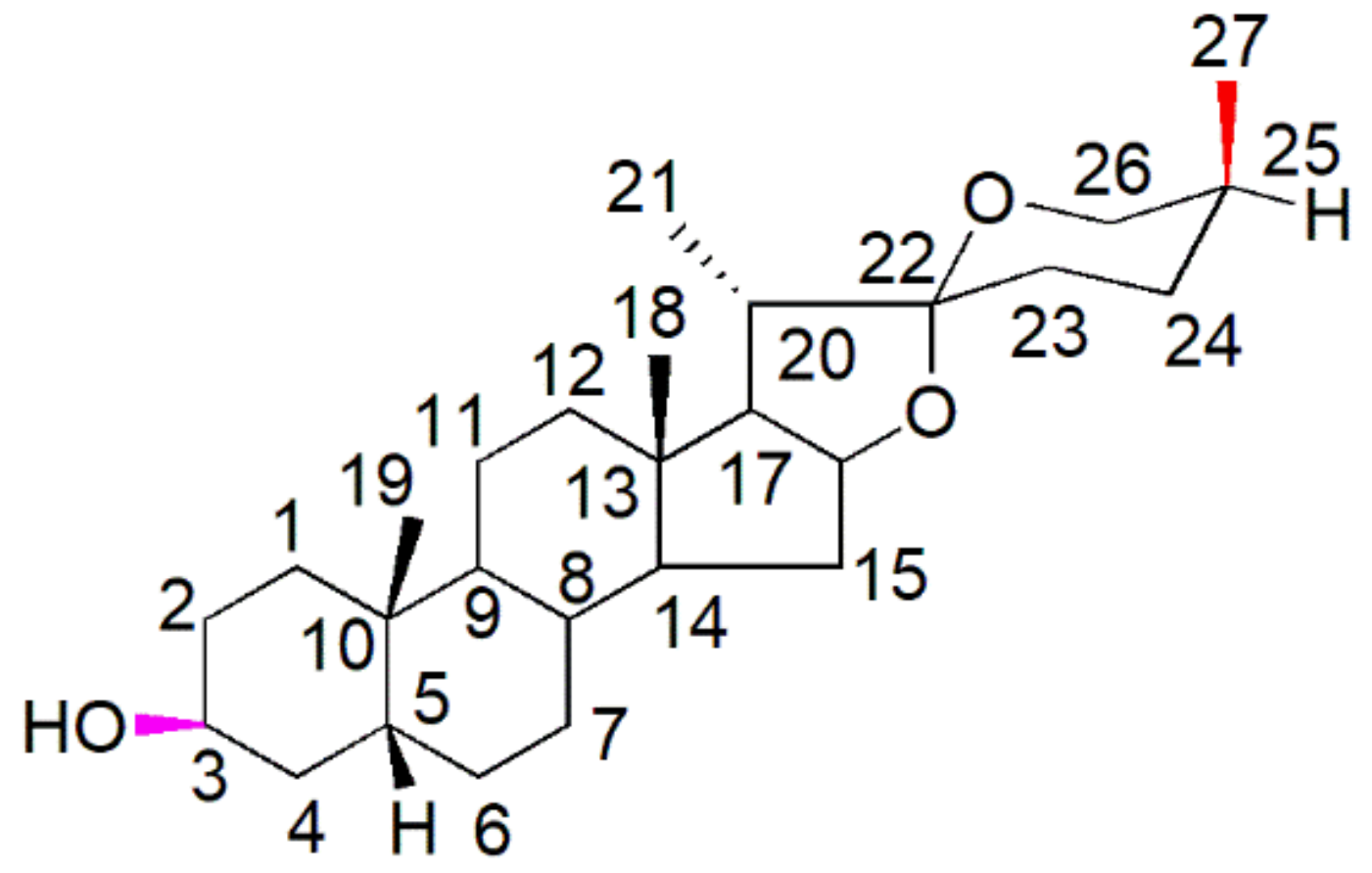
Sarsasapogenin is a lipophilic phytosteroidal sapogenin featuring a distinct spirostanol ring. Upon local transdermal delivery into the subcutaneous layer, it acts through a targeted sequence:
A. Triggering Preadipocyte Differentiation (Hyperplasia)
Once sarsasapogenin diffuses into the subcutaneous matrix, it binds to intracellular targets that up-regulate PPAR-γ—the master genetic switch controlling adipocyte formation. PPAR-γ works alongside CCAAT/enhancer-binding protein alpha (C/EBP-α) to recruit dormant stem-cell-derived preadipocytes, prompting them to differentiate into mature, fully functional fat-storing cells.
B. Driving Intracellular Lipid Accumulation (Hypertrophy)
In pre-existing and newly differentiated adipocytes, sarsasapogenin up-regulates SREBP-1c (Sterol Regulatory Element-Binding Protein 1c). This enhances glucose uptake via GLUT4, accelerating the conversion of fatty acids into triglycerides. The resulting expansion of intracellular lipid droplets increases total adipose tissue density.
3. Clinical Validation: What the Science Confirms
1. PPAR-γ Signalling and Adipocyte Differentiation Dynamics
In foundational cell biology studies published in Biochimie (PubMed), titled “PPAR gamma and the Control of Adipogenesis,” researchers identified the precise pathway governing fat cell recruitment.
The empirical data demonstrated that PPAR-γ activation is necessary and sufficient to convert uncommitted preadipocytes into mature adipocytes capable of storing lipids. The study verified that molecules capable of activating PPAR-γ induce preadipocyte differentiation, proving that targeting this nuclear receptor restores lost subcutaneous volume at a cellular level.
2. Sarsasapogenin-Induced Lipid Accumulation & Adipose Modulation
In a clinical trial published in Acta Pharmacologica Sinica (PMC), titled “Sarsasapogenin Improves Adipose Tissue Inflammation and Ameliorates Metabolic Dysfunction,” investigators evaluated sarsasapogenin’s direct effects on adipocyte health.
The research confirmed that sarsasapogenin modulates adipocyte cellular pathways, suppressing pro-inflammatory cascades (such as TNF-α) that trigger fat breakdown, while supporting adipocytes’ structural integrity and nutrient uptake. The study concluded that sarsasapogenin exerts a direct, protective, and regulatory effect on adipose tissue.
3. Layer-Specific Subcutaneous Adipogenic Potential
In a comparative study published in the American Journal of Physiology (PubMed), titled “Human Adipocytes from the Subcutaneous Superficial Layer Have Greater Adipogenic Potential,” researchers analyzed how target subcutaneous fat pads respond to biostimulation.
The findings revealed that subcutaneous adipocytes exhibit high sensitivity to exogenous PPAR-γ signaling, demonstrating increased triglyceride accumulation and cell expansion when stimulated. This confirms that localized delivery of PPAR-γ activators to mid-face subcutaneous layers effectively reverses structural volume loss.
4. Practice Summary
Sarsasapogenin offers a targeted, biostimulatory approach to restoring lost mid-face volume. By directly stimulating PPAR-γ transcription within subcutaneous fat pads, aesthetic practitioners can promote natural preadipocyte differentiation and lipid accumulation. This localized volumizing mechanism rebuilds malar projection, softens tear trough hollows, and restores youthful contours from within.
Study Citations & References
- Study 1 (PPAR-γ Modulation & Adipocyte Differentiation): PPAR gamma and the control of adipogenesis.URL: https://pubmed.ncbi.nlm.nih.gov/9209705/
- Study 2 (Sarsasapogenin Action on Adipose Tissue): Sarsasapogenin improves adipose tissue inflammation and ameliorates insulin resistance in high-fat diet-fed C57BL/6J mice.URL: https://pmc.ncbi.nlm.nih.gov/articles/PMC8027656/
- Study 3 (Subcutaneous Adipocytes & PPAR-γ Responsiveness): Human adipocytes from the subcutaneous superficial layer have greater adipogenic potential and lower PPAR-γ DNA methylation levels than deep layer adipocytes.URL: https://pubmed.ncbi.nlm.nih.gov/27251439/
Frequently Asked Questions
Disclaimer: The content provided in the Ninaveli Knowledge Hub is for informational and educational purposes only. This content is not intended to be a substitute for professional medical advice, diagnosis, or treatment and should not be used as such. Always seek the advice of a qualified healthcare provider or dermatologist with any questions you may have regarding a medical condition or before starting any new skincare regimen. Ninaveli does not guarantee the accuracy, completeness, or timeliness of the information provided and assumes no liability for any actions taken based on this content.
