Decoding the Biological Mechanisms of Cellular Repair and Dermal Hydration
The landscape of minimally invasive aesthetic medicine is undergoing a profound evolution. For over a decade, the clinical default for treating skin laxity, fine lines, and superficial dehydration has been non-crosslinked or lightly crosslinked Hyaluronic Acid (HA) skin boosters. However, the rapid emergence of regenerative aesthetics has introduced a formidable alternative: Polynucleotides (PN).
As practitioners increasingly transition toward long-term tissue biostimulation, understanding the microscopic distinctions between these two therapeutic modalities is essential. They are not merely different products; they represent entirely distinct biological philosophies.
The Molecular Architecture: How they differ at a Cellular Level
To understand their divergent clinical outcomes, one must look at how these molecules interact with the extracellular matrix (ECM) and dermal cell populations.
Hyaluronic Acid Boosters: The Hydrophilic Matrix Plumper
Non-cross-linked Hyaluronic Acid is a naturally occurring glycosaminoglycan with immense hydrophilic properties. Its primary mechanism of action is mechanical. Upon injection into the superficial or mid-dermis, HA molecules instantly attract and bind up to 1,000 times their molecular weight in water.
This rapid influx of moisture expanding the extracellular space creates an immediate “plumping” effect, smoothing out fine lines and providing an overnight glow. However, HA boosters are passive; they provide an optimal environment for skin cells, but they do not directly instruct those cells to behave differently. Furthermore, native HA is rapidly degraded by endogenous hyaluronidase enzymes, requiring frequent maintenance cycles.
However, cross-linked Hyaluronic Acid (HA) that is used in the Ninaveli HA Filler range has a slightly different and more sophisticated atomic structure to boost longevity: the cross-linking of HA makes it chemically bound into a firmer, mesh-like structure, allowing it to act as a structural scaffolding that resists enzymatic breakdown for a much longer period of time, allowing the HA to remain inside body for longer, resulting in a much higher quality dermal filler.
Polynucleotides: The Epigenetic Cellular Signalers
Polynucleotides, such as the highly purified salmon-DNA fractions utilized in the Ninaveli range, operate via a completely different pathway. PN molecules are long-chain nucleotide polymers that do not rely on water binding for their primary effect. Instead, they function as biostimulators and cell-signaling molecules.
When introduced into the dermis, polynucleotides bind directly to cell surface purinergic (A2A) receptors. This binding triggers an intracellular cascade that directly commands dermal fibroblasts to multiply and dramatically increase their production of endogenous Type I collagen, Type III collagen, and elastin. Instead of temporarily filling the gaps with water, PN therapy structurally rebuilds the dermal scaffold from within.
Clinical Comparison: Immediate Hydration vs. Structural Regeneration
Because their cellular mechanisms are completely distinct, their clinical indications, onset of action, and longevity vary significantly:
| CLINICAL PARAMETER | TRADITIONAL HA SKIN BOOSTERS | ADVANCED POLYNUCLEOTIDES (PN) |
| Primary Action | Passive water retention & matrix hydration | Active fibroblast stimulation & tissue repair |
| Onset of Visual Results | Immediate (within 24-48 hours usually) | Progressive (optimal at 4-6 weeks) |
| Neocollagenesis | Indirect (due to mechanical stretch) | Direct (via purinergic receptor activation) |
| Longevity of Outcome | Short-term (typically 2-4 months) | Long-term (6-9 months via cellular remodeling) |
| Target Demographics | Acute dehydration, superficial dullness | Skin atrophy, scarring, elastosis, dark circles |
The Anti-Inflammatory Advantage of Nucleotide Therapy
One of the most significant clinical advantages of Polynucleotides over traditional skin boosters is their profound impact on tissue inflammation. Chronic low-grade dermal inflammation—often termed “inflammaging”—is a primary driver of collagen degradation and hyperpigmentation.
While high volumes of HA can occasionally exacerbate localized swelling or trigger a minor foreign-body response in compromised tissue, Polynucleotides are highly biocompatible and actively anti-inflammatory. The salvage pathway of PN degradation releases free purine and pyrimidine bases that scavenge free radicals, neutralize oxidative stress, and downregulate pro-inflammatory cytokines. This makes PN treatments exceptionally safe for highly sensitive areas, such as the perioral and periorbital zones, where traditional HA boosters risk causing chronic puffiness or a visible Tyndall effect.
The Future Belongs to Hybrid Protocols
For the modern practitioner, the clinical objective should not be choosing one modality over the other, but rather mastering their strategic combination. Combining the immediate, high-impact hydration of dual-weight Hyaluronic Acid with the deep, long-term regenerative power of Polynucleotides represents the absolute pinnacle of modern skin rejuvenation.
By utilizing advanced hybrid configurations—such as pre-blended matrices that deliver both polymers in a single session—clinics can satisfy the modern patient’s demand for instant cosmetic gratification while simultaneously reversing cellular senescence for enduring dermal health.
Experience Cellular Synergy with the Ninaveli Hybrid Range
Practitioners no longer need to compromise between immediate dermal plumping and long-term tissue biostimulation. The Ninaveli catalogue features a premier selection of co-formulated matrices engineered to unlock this exact cellular synergy in a single treatment session:
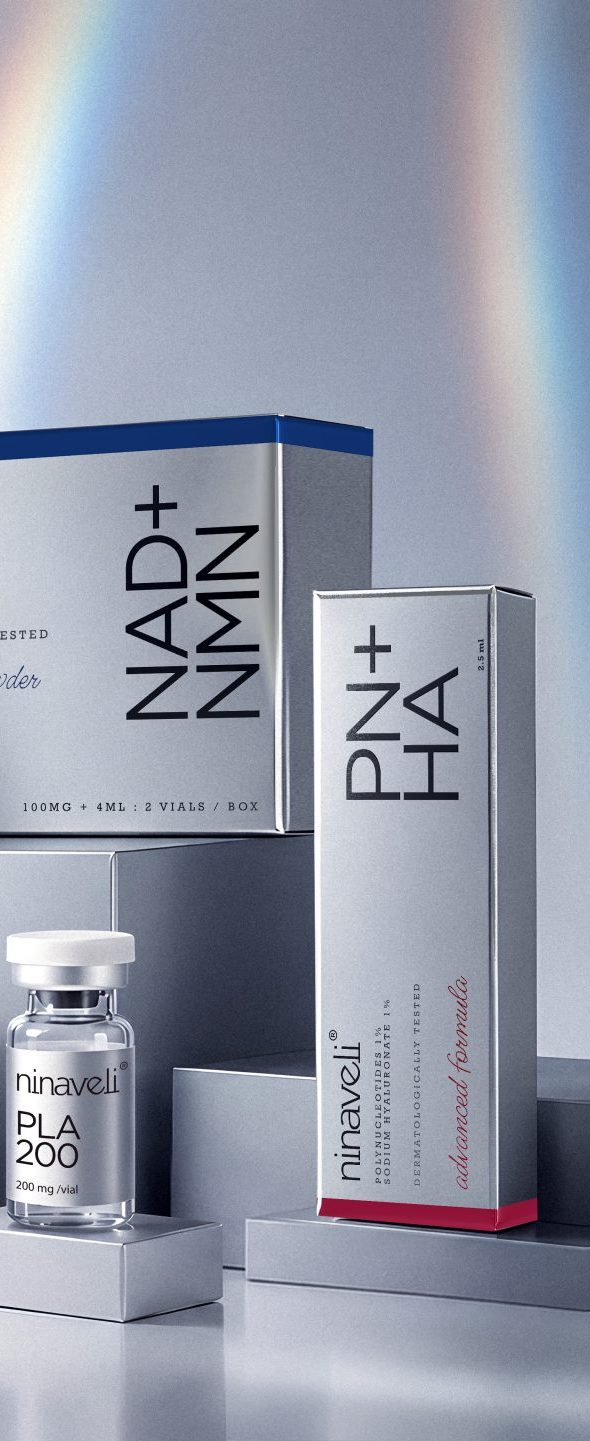
- Ninaveli PN+HA: The flagship hybrid model, delivering a balanced 1% Polynucleotides and 1% Hyaluronic Acid matrix (10mg/ml PN + 10mg/ml HA) in a 2.5ml syringe to treat concurrent tissue degradation and severe dehydration.
- Ninaveli HI-LO: An ultra-potent hybrid complex combining 70mg of High Molecular Weight HA (H_HA), 10mg of Low Molecular Weight HA (L-HA) and 0.5% pure Polynucleotides to target immediate extracellular volume alongside profound fibroblast repair.
- Ninaveli Face Glow: A premium 5ml sterile vial combining 1% Polynucleotides (PN), 1% Hyaluronic Acid (HA) and Glutathione to deliver an advanced, broad-area mesotherapy solution that simultaneously brightens skin tone and repairs deep structural matrices.
By introducing these dual-action nucleotide-and-hyaluronic formulations into your clinic, you provide patients with the instant cosmetic gratification of traditional skin boosters alongside the enduring clinical longevity of South Korean regenerative aesthetics.
