Maximizing Structural Neocollagenisis While Minimizing Nodule Risks in Modern Practice
Dermal rejuvenation has progressed far beyond the boundaries of traditional cross-linked hyaluronic acid. While HA hydrogels excel at immediate volume placement, they do not halt or reverse the underlying structural decline of the aging extracellular matrix. To achieve true structural architecture, modern clinical protocols are shifting toward advanced biostimulators and cellular signaling complexes.
Technologies such as Poly-D,L-Lactic Acid (PDLLA), Calcium Hydroxylapatite (CaHA), and freeze-dried exosomes have become the gold standard for long-term tissue restoration. However, historical formulations often presented clinical challenges, including unpredictable swelling, demanding reconstitution times, and the risk of nodule formation. Today, advanced South Korean molecular engineering has solved these friction points, providing practitioners with unmatched safety and predictable structural outcomes.
PDLLA vs. Traditional PLLA: The Evolution of Poly-Lactic Acids
For years, Poly-L-Lactic Acid (PLLA) was the dominant force in structural biostimulation. While highly effective at inducing collagen synthesis, its highly crystalline molecular structure required lengthy reconstitution periods and carried a noted risk of late-onset subcutaneous nodules if not aggressively massaged post-treatment.
The Uniform Micro-Spherical Breakthrough
The evolution from PLLA to Poly-D,L-Lactic Acid (PDLLA) represents a massive leap forward in patient safety and clinical convenience. PDLLA features an amorphous, porous molecular structure shaped into perfectly uniform micro-spheres. When injected, these micro-spheres distribute evenly within the tissue without clumping.
Fibroblasts smoothly migrate into the porous structure of the spheres, triggering a highly predictable cascade of Type I collagen and elastin synthesis. Because the degradation profile of PDLLA is completely uniform and smooth, the risk of nodule formation is virtually eliminated.
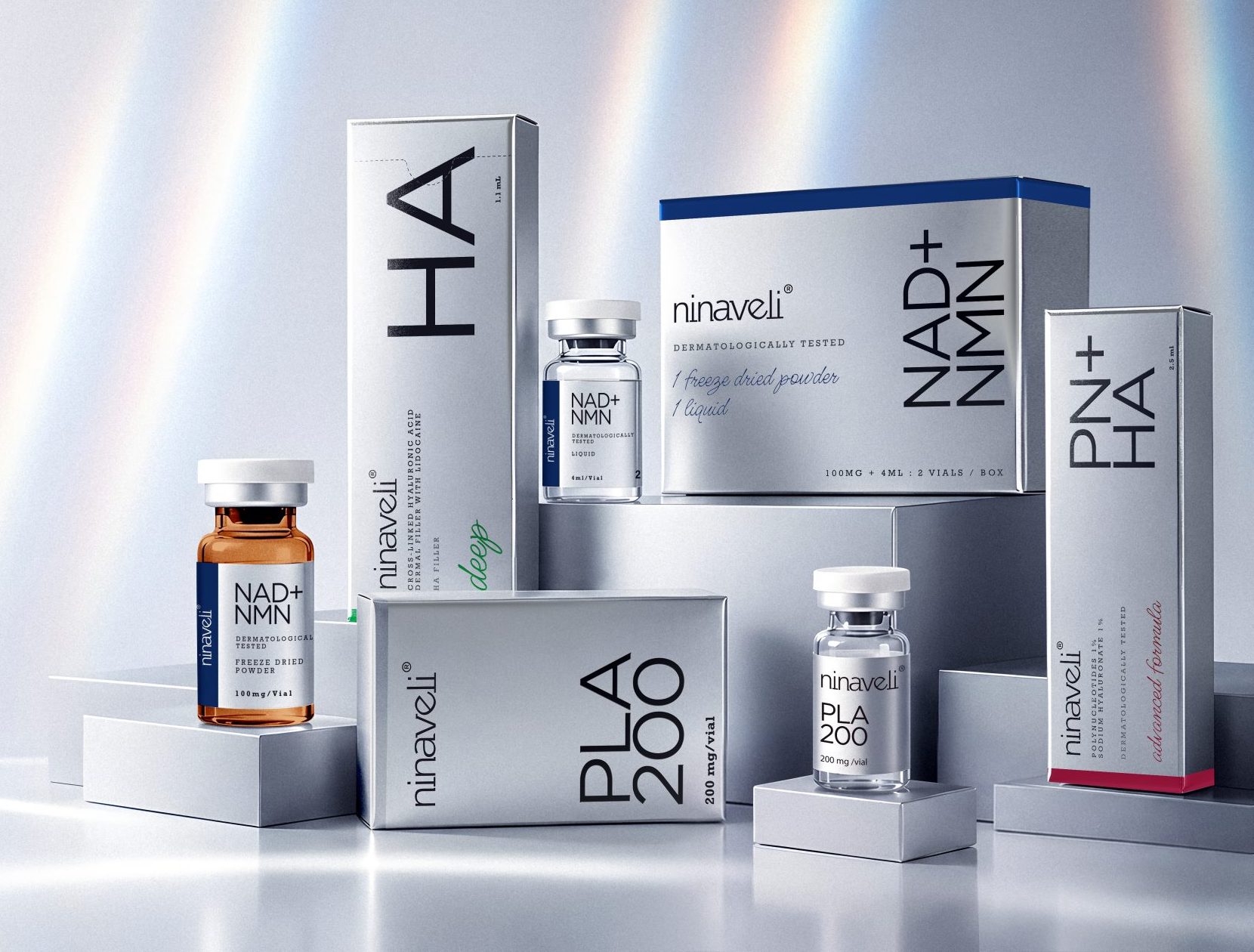
The Ninaveli portfolio directly leverages this advanced science with Ninaveli PLA 200. Comprising 200mg of highly pure PDLLA seamlessly paired with Carboxymethylcellulose (CMC), this sterile vial provides a smooth, rapid reconstitution and an incredibly low nodule formation risk profile. For practitioners seeking to correct deep facial folds and global volume loss, it delivers a predictable, stable, and highly rewarding biostimulatory response.
Calcium Hydroxylapatite (CaHA): High-Cohesivity Mineral Vectors
Another titan of the biostimulatory space is Calcium Hydroxylapatite (CaHA). Unlike poly-lactic acids, which act slowly over several months, CaHA provides a dual-action therapeutic pathway. Upon injection, the gel matrix delivers an immediate mechanical scaffolding effect, instantly contouring areas like the jawline, zygomatic arch, and chin.
Over the subsequent weeks, the carboxymethylcellulose gel carrier degrades naturally, leaving behind uniform mineral micro-spheres. These spheres stimulate a powerful wave of neocollagenesis, completely replacing the temporary gel with a permanent matrix of the patient’s own natural tissue.
The Ninaveli CaHA 1ml syringe profile represents the absolute pinnacle of this technology. Developed through advanced South Korean engineering, our signature formulation features perfectly calibrated, smooth, micro-spherical particles that ensure a highly controlled extrusion force. This gives the clinician maximum precision when sculpting the facial architecture. By providing immediate structural lift followed by a predictable, long-term surge in natural collagen synthesis, Ninaveli CaHA allows practitioners to deliver sharp, definitive facial contouring without the risk of over-volumizing, migration, or late-stage nodule complications.
Exosomal Signalling: The Absolute Peak of Regenerative Biotechnology
While biostimulators rebuild the macro-structures of the dermis, true cellular optimization requires direct intercellular communication. This is where exosomes step in. Exosomes are microscopic extracellular vesicles that act as the cell’s delivery system, carrying vital proteins, growth factors, and mRNA directly to tired or damaged skin cells.
Overcoming Topical Volatility via Lyophilization
The primary clinical hurdle with exosomes has always been molecular stability; liquid exosome solutions quickly degrade if not kept in extreme sub-zero temperatures. South Korean biotechnology has bypassed this constraint through advanced lyophilization (freeze-drying), which locks the volatile vesicles in a stable, dormant state until the moment of application.
This peak tier of regenerative science is perfectly realized in Ninaveli Exosomes (Exoleen). Utilizing a state-of-the-art dual-vial system, Vial 1 preserves 800mg of freeze-dried Ginseng Root Exosomes, Mannitol, and Trehalose. When mixed with Vial 2—a 4ml liquid activator rich in pure Polynucleotides, Hyaluronic Acid, Proteoglycans, Peptides, and Tranexamic Acid—it forms an incredibly potent matrix that down-regulates melanocyte activity, accelerates cell turnover, and repairs barrier dysfunction.
For comprehensive systemic mitochondrial support, practitioners can also implement Ninaveli NAD+ NMN, which combines a lyophilized 100mg NMN + Nicotinamide Riboside (NR) powder vial with an amino acid and HA activating liquid to target cellular senescence at its source.
Establishing the Modern Regenerative Protocol
The future of aesthetic medicine does not rely on expanding tissues with foreign substances, but on prompting the body to repair itself. By integrating advanced South Korean biostimulators like Ninaveli PLA 200 to restore structural skeletal framework, alongside specialized cellular signalers like Ninaveli Exoleen Exosomes, modern clinics can offer highly customized treatment maps. This approach ensures total safety compliance, zero logistical friction, and the elegant, age-reversing results that modern aesthetic patients demand.
