Quick Facts & Executive Summary
| Attribute | Specification |
| INCI Name | Soluble Proteoglycan |
| Ingredient Class | Glycosylated Macromolecular Complex / Extracellular Matrix Active |
| Primary Biological Target | Fibroblast Growth Factor Receptors (FGFR) & Dermal Collagen Fibrils |
| Primary Aesthetic Outcome | Structural Matrix Organization, Deep Hydration & Elasticity Restoration |
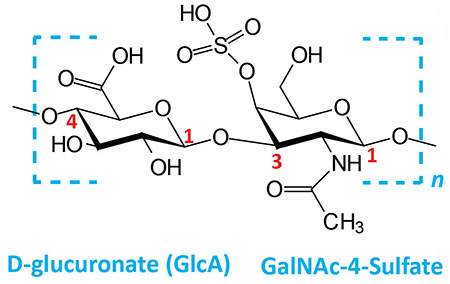
Proteoglycans are complex, heavily glycosylated macromolecules consisting of a core protein covalently bonded to glycosaminoglycan (GAG) chains such as chondroitin sulfate and dermatan sulfate. In advanced regenerative aesthetics, Proteoglycans serve as essential architectural organizers within the extracellular matrix, binding water molecules tightly to maintain tissue turgor, organizing collagen fibril assembly, and regulating cell-signaling pathways necessary for structural skin repair.
What is Proteoglycan? (Definition & Origin)
Proteoglycans are high-molecular-weight glycoproteins naturally found in high concentrations throughout the human dermal extracellular matrix, joint cartilage, and basement membranes. Their molecular architecture resembles a “bottle-brush” structure, where a central core protein is attached to long, negatively charged glycosaminoglycan (GAG) side chains.
For advanced aesthetic and cosmetic applications, high-purity Proteoglycans are extracted using sophisticated bio-refinement techniques (such as extraction from marine nasal cartilage) to yield water-soluble, highly bio-compatible actives.
Because of their heavy polyanionic charge, Proteoglycans possess an extraordinary water-retention capacity. They do not act merely as surface humectants; rather, they form a gel-like hydrated cushion around collagen and elastin fibers, providing crucial mechanical cushioning and regulating the transport of growth factors across living tissue.
The Science & Cellular Mechanism of Action
Proteoglycans operate at the cellular and molecular level through three primary physiological pathways:
- Hydrated Matrix Formation & Osmotic Retention: The negatively charged sulfate and carboxylate groups on the GAG side chains attract positive cations (such as sodium ions), establishing a strong osmotic gradient. This dynamic allows Proteoglycans to bind vast amounts of water within the interstitial space, maintaining dermal turgor, plumpness, and viscoelastic resilience.
- Regulation of Collagen Fibrillogenesis & Spatial Alignment: Small leucine-rich proteoglycans (SLRPs), such as decorin and lumican, bind directly to specific sites on collagen Type 1 molecules. This interaction controls the rate and spatial orientation of collagen fibril assembly, preventing chaotic cross-linking and ensuring proper structural alignment within the dermis.
- Epidermal Growth Factor (EGF)-Like Cell Signaling: Specific domains within Proteoglycan structures can interact directly with cell surface receptors, such as Fibroblast Growth Factor Receptors (FGFR) and EGFR. This binding triggers intracellular signaling cascades that stimulate keratinocyte proliferation, activate dermal fibroblasts, and upregulate endogenous collagen and hyaluronic acid synthesis.
Clinical Evidence & Direct Skin Impact
Because Proteoglycans organize dermal collagen architecture and bind deep interstitial hydration, their inclusion in aesthetic formulations directly influences tissue firmness and structural elasticity.
- Dramatically Improves Dermal Hydration & Suppleness: Clinical trials demonstrate that topical and dermal administration of Proteoglycans significantly increases stratum corneum moisture content, outperforming standard hyaluronic acid in long-term water retention.
- Enhances Skin Firmness & Structural Elasticity: In vivo evaluations assessing mature and photo-damaged skin show that Proteoglycan formulations improve skin elasticity, reduce the visual depth of wrinkles, and restore mechanical firmness across the skin matrix.
- Accelerates Barrier Repair & Cell Renewal: In vitro research reveals that Proteoglycans stimulate cell proliferation and migration, accelerating epidermal re-epithelialization and tissue recovery following environmental or procedure-induced skin stress.
Ninaveli’s Strategic Formulations
At Ninaveli, we incorporate high-purity Proteoglycan into our advanced regenerative aesthetic product range, specifically featured in the following signature formulation:
- Ninaveli Exoleen: Formulated with Proteoglycan alongside Polynucleotides (PN), Hyaluronic Acid (HA), Peptides, and Tranexamic Acid in activating liquid vial 2.
Clinical Study References
- Carrino, D. A., et al. (2000). Age-related changes in human skin proteoglycans. Archives of Biochemistry and Biophysics, 373(1), 91-101.Read Study on PubMed (DOI: 10.1006/abbi.1999.1534)
- Takeda, K., et al. (2018). Effects of soluble proteoglycan on human skin properties: A randomized, double-blind, placebo-controlled study. Journal of Cosmetic Dermatology, 17(4), 610-616.Read Study on PubMed (DOI: 10.1111/jocd.12428)
- Szturmowicz, M., et al. (2019). Proteoglycans in skin health and etiology of skin aging. International Journal of Molecular Sciences, 20(21), 5327.Read Study on PubMed (DOI: 10.3390/ijms20215327)
Frequently Asked Questions
Disclaimer: The content provided in the Ninaveli Knowledge Hub is for informational and educational purposes only. This content is not intended to be a substitute for professional medical advice, diagnosis, or treatment and should not be used as such. Always seek the advice of a qualified healthcare provider or dermatologist with any questions you may have regarding a medical condition or before starting any new skincare regimen. Ninaveli does not guarantee the accuracy, completeness, or timeliness of the information provided and assumes no liability for any actions taken based on this content.
