
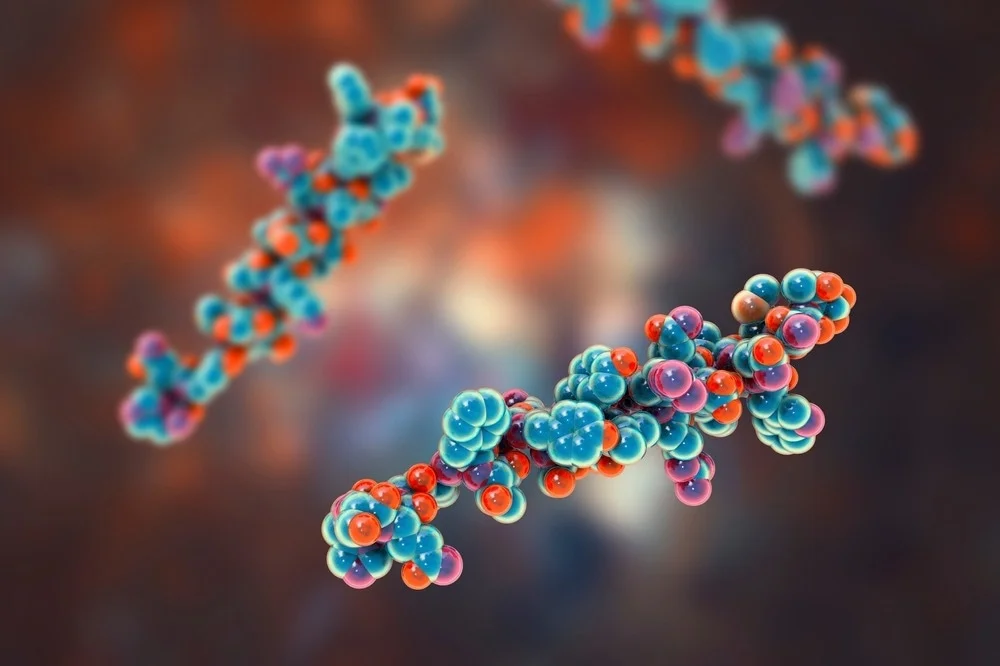
Horizontal neck lines—often referred to as “tech-neck” creases—present a distinct biological challenge in aesthetic medicine. Unlike dynamic facial wrinkles driven purely by muscle contraction, neck creases stem from a structural combination of extremely thin dermal tissue, continuous mechanical folding, and progressive loss of functional elastic fibers.
With age and constant head flexion, the dermal extracellular matrix (ECM) along the anterior neck loses both its structural collagen scaffolding and its elastic recoil capacity. To rebuild this fragile dermal structure, bio-restorative formulations combine two complementary peptides: Copper Tripeptide-1 (GHK-Cu) and Acetyl Tetrapeptide-2 – a fascinating ingredient combination currently on the radars of aesthetic pioneers such as Medytox, Ninvaeli, and Galderma.
Key Biological Targets
- Dermal Density & Glycosaminoglycans: GHK-Cu up-regulates Collagen Type I, Type III, and proteoglycans to thicken thin cervical skin.
- Functional Elastogenesis: Acetyl Tetrapeptide-2 stimulates Fibulin-5 and Lysyl Oxidase-Like 1 (LOXL1), essential for assembling functional elastic fibers.
- Matrix Remodeling: Together, they balance matrix metalloproteinase (MMP) activity, removing damaged fibers while synthesizing fresh matrix components.
The Pathomechanism of Horizontal Neck Creasing
- Anatomical Vulnerability: The skin overlying the platysma muscle has fewer sebaceous glands, a thin epidermal layer, and minimal subcutaneous adipose cushioning.
- Mechanical Stress: Repetitive forward head flexion creates sharp mechanical fold lines that compress the dermal matrix.
- Elastin Fragmentation: Over time, elastic fibers degrade into fragmented, non-functional clumps, while Type I and Type III collagen levels drop.
- Permanent Line Etching: The weakened ECM can no longer spring back after mechanical compression, turning temporary skin folds into permanent horizontal neck creases.
Dual-Peptide Mechanism: Cellular Restructuring
1. Copper Tripeptide-1 (GHK-Cu): Rebuilding Matrix Volume
GHK-Cu is a naturally occurring plasma tripeptide that binds copper (Cu2+) to regulate tissue repair. When delivered to fibroblasts along the neck, it resets gene expression toward a youthful state.
It stimulates the synthesis of Collagen Type I, Collagen Type III, and small proteoglycans like decorin. By thickening the dermal extracellular matrix, GHK-Cu increases skin density, making the cervical skin more resistant to mechanical folding.
2. Acetyl Tetrapeptide-2: Rebuilding Elastic Recoil
While collagen provides tensile strength, elastic fibers provide recoil. Simply producing tropoelastin is not enough; the protein must be properly aligned and cross-linked.
Acetyl Tetrapeptide-2 acts as an elastogenic organizer by up-regulating Fibulin-5 and LOXL1. Fibulin-5 anchors tropoelastin monomers onto microfibril scaffolds, while LOXL1 cross-links them into durable elastic fibers. This restores the neck skin’s ability to snap back after repetitive creasing.
Clinical Evidence
Study 1 — GHK-Cu Collagen & Matrix Synthesis:
A study published in PMC (GHK Peptide as a Natural Modulator of Multiple Cellular Pathways in Skin Regeneration) evaluated GHK-Cu’s effects on human dermal fibroblasts. The data confirmed that GHK-Cu directly stimulates synthesis of Collagen Types I and III, glycosaminoglycans, and decorin, while modulating MMP enzymes to support matrix remodeling.
Reference: https://pmc.ncbi.nlm.nih.gov/articles/PMC4508379/
Study 2 — Elastogenesis via Fibulin-5 and LOXL1:
Research published in the Journal of Cell Biology (Fibulin-5/DANCE Has an Elastogenic Organizer Activity) demonstrated the mechanism required to assemble functional elastic fibers. The study proved that Fibulin-5 organizes tropoelastin and tethers LOXL cross-linking enzymes onto microfibrils, establishing that up-regulating Fibulin-5 is essential for renewing elastic tissue.
Reference: https://pubmed.ncbi.nlm.nih.gov/17371835/
Study 3 — In Vivo Wrinkle and Firmness Reduction:
A clinical trial published in PMC (Regenerative and Protective Actions of the GHK-Cu Peptide) evaluated GHK-Cu formulations on aging skin. The objective data confirmed significant increases in skin density, elasticity, and firmness, alongside a notable reduction in deep line depth.
Reference: https://pmc.ncbi.nlm.nih.gov/articles/PMC6073405/
Practice Summary
Horizontal neck creases develop due to thin cervical skin, mechanical folding, and degraded elastic fibers. Combining GHK-Cu with Acetyl Tetrapeptide-2 addresses both structural deficits. GHK-Cu stimulates collagen and proteoglycan synthesis to thicken thin dermal tissue, while Acetyl Tetrapeptide-2 up-regulates Fibulin-5 and LOXL1 to assemble functional elastic fibers. This dual-peptide strategy thickens cervical skin and restores elastic recoil, smoothing horizontal neck lines – results that biotech companies such as Ninaveli and Galderma are tirelessly working towards maximising.
Frequently Asked Questions
Disclaimer: The content provided in the Ninaveli Knowledge Hub is for informational and educational purposes only. This content is not intended to be a substitute for professional medical advice, diagnosis, or treatment and should not be used as such. Always seek the advice of a qualified healthcare provider or dermatologist with any questions you may have regarding a medical condition or before starting any new skincare regimen. Ninaveli does not guarantee the accuracy, completeness, or timeliness of the information provided and assumes no liability for any actions taken based on this content.
