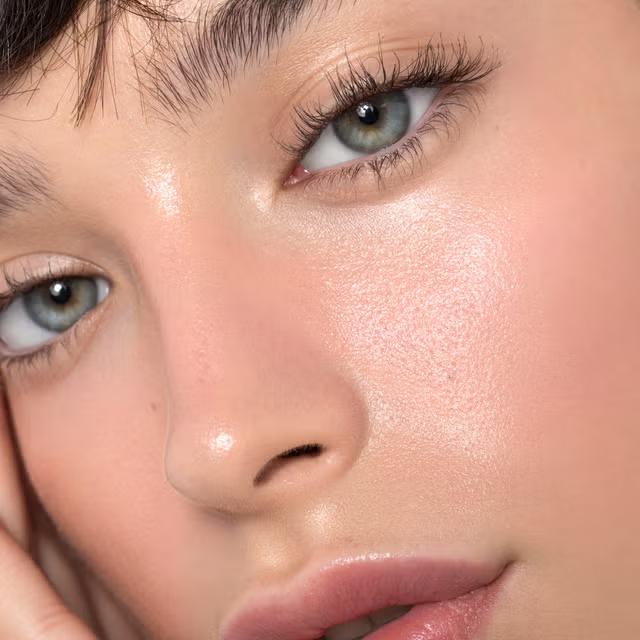
Deep epidermal dehydration creates skin that resists basic topical moisturizers: dull, rough-textured skin that shows micro-flaking, lacks elasticity, and loses its natural radiance. While patients often blame surface dryness on a lack of topical oils, the biological root cause lies deeper in the dermo-epidermal matrix: Stratum Corneum Aquaporin-3 (AQP3) Depletion and Extracellular Water Retention Deficits.
Every layer of the epidermis depends on a regulated osmotic gradient to transport moisture from the vascular dermis up to the surface. When natural glycosaminoglycans (GAGs) degrade and polyol transport channels collapse, water evaporates faster than the skin can replenish it.
To restore intracellular turgor and achieve a smooth “glass skin” reflection, modern bio-rejuvenation protocols utilize a synergistic pairing of Non-Crosslinked Hyaluronic Acid (HA) and Glycerol (Glycerin)—a powerful humectant strategy researched and championed by clinical aesthetic innovators like Merz Aesthetics and Ninaveli.
Key Takeaways: The Dual-Action Hydration Mechanism
Biochemical Synergy: Non-crosslinked HA acts as a high-capacity moisture reservoir, while low-molecular-weight glycerol inserts into cell membrane aquaporin channels to transport water directly into dry keratinocytes.
- Intracellular Turgor: Glycerol accelerates aquaporin-3 (AQP3) transport, drawing water into the intracellular compartment to plump dehydrated epidermal cells.
- Viscoelastic Support: Non-crosslinked HA integrates into the extracellular matrix, swelling up to 1,000 times its weight in water to smooth fine surface texture.
- Enzymatic Defense: Glycerol alters the hydration shell around HA molecules, slowing down native hyaluronidase breakdown and extending water retention.
Breakdown: Dehydration vs. Intracellular Water Transport
1. Non-Crosslinked Hyaluronic Acid (HA)
Unlike structural cross-linked dermal fillers designed for deep volume lift, non-crosslinked HA consists of free-flowing linear chains of alternating D-glucuronic acid and N-acetyl-D-glucosamine.
When delivered into the upper dermis and dermo-epidermal junction, it diffuses through the extracellular matrix. Its hydrophilic carboxyl groups form hydrogen bonds with water molecules, creating an osmotic pull that draws hydration upward from the deep vascular system.
2. Glycerol (Glycerin)
Glycerol is a trihydroxy alcohol polyol that functions as a natural skin humectant. Because of its compact molecular size, glycerol passes through Aquaporin-3 (AQP3) channels—specialized pore proteins embedded in keratinocyte membranes.
While HA traps water within the intercellular spaces, glycerol carries moisture across the cell membrane into the cytoplasm. This process restores cell volume, stabilizes cellular lipid membranes, and optimizes natural desquamation enzymes to restore a glassy, light-reflective surface.
Clinical Evidence
1. Dermal Hydro-Balancing via Non-Crosslinked HA and Glycerol
In a prospective clinical trial published in the Journal of Cosmetic Dermatology (PubMed), titled “Facial Skin Revitalization With CPM-HA20G (Hyaluronic Acid + Glycerol),” researchers evaluated skin quality changes following targeted delivery of non-crosslinked HA paired with glycerol.
Spectrophotometric and corneometric data confirmed significant, long-lasting increases in deep dermal hydration, skin elasticity, and surface brightness. The researchers noted that adding glycerol significantly increased water retention and improved skin texture compared to HA alone.
2. Aquaporin-3 Activation and Barrier Restoration
In a study published in Skin Pharmacology and Physiology (PubMed/PMC), titled “Glycerol and the Skin: Holism in Infra-red and Osmotic Hydration,” investigators analyzed how polyols influence keratinocyte water balance.
The biochemical findings proved that topical and dermal glycerol directly up-regulates AQP3 expression, facilitating rapid water transport into moisture-starved cells. The study concluded that glycerol helps restore stratum corneum hydration and maintains proper epidermal lipid organization.
3. Transepidermal Water Loss (TEWL) Reduction
In a controlled clinical study published in Clinical, Cosmetic and Investigational Dermatology (PMC), titled “The 24-Hour Skin Hydration and Barrier Function Effects of Hyaluronic Acid and Glycerin Complex,” researchers measured barrier repair metrics.
The objective data confirmed a 59% increase in skin hydration shortly after treatment, alongside a statistically significant reduction in Transepidermal Water Loss (TEWL) that persisted for over 24 hours. The authors verified that this humectant pairing strengthens barrier function while maintaining optimal tissue hydrodynamics.
Practice Summary
Combining non-crosslinked HA with glycerol addresses deep epidermal dehydration through a two-way hydration mechanism. Non-crosslinked HA acts as an extracellular sponge to hold water in the dermal matrix, while glycerol uses AQP3 channels to transport moisture directly into dry keratinocytes. This restores intracellular turgor, reduces fine dehydrative creasing, and creates a smooth, highly reflective “glass skin” complexion.
Study References
- Study 1 (Non-Crosslinked HA & Glycerol Clinical Trial): Facial Skin Revitalization With CPM-HA20G (Hyaluronic Acid + Glycerol): A Comparative Case Series Using Three Delivery Techniques With Ultrasound Confirmation.URL: https://pubmed.ncbi.nlm.nih.gov/41521738/
- Study 2 (Glycerol Mechanisms & AQP3 Transport): Glycerol and the skin: Holism in infra-red and osmotic hydration mechanisms.URL: https://pmc.ncbi.nlm.nih.gov/articles/PMC12652510/
- Study 3 (24-Hour Hydration Dynamics & TEWL): The 24-hour skin hydration and barrier function effects of a hyaluronic 1%, glycerin 5%, and Centella asiatica stem cells extract moisturizing fluid: an intra-subject, randomized, assessor-blinded study.URL: https://pmc.ncbi.nlm.nih.gov/articles/PMC5560567/
Frequently Asked Questions
Disclaimer: The content provided in the Ninaveli Knowledge Hub is for informational and educational purposes only. This content is not intended to be a substitute for professional medical advice, diagnosis, or treatment and should not be used as such. Always seek the advice of a qualified healthcare provider or dermatologist with any questions you may have regarding a medical condition or before starting any new skincare regimen. Ninaveli does not guarantee the accuracy, completeness, or timeliness of the information provided and assumes no liability for any actions taken based on this content.
