
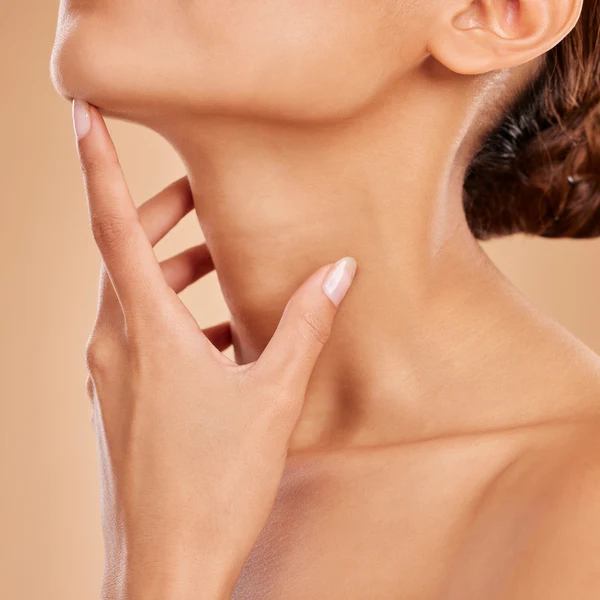
In an age dominated by smartphones, tablets, and laptops, the aesthetic industry has seen a massive surge in a once-niche complaint: “Tech-Neck.”
Patients are noticing deep, horizontal crease lines running across their necks, alongside a premature loss of elasticity and rough surface texture. Because the skin on the neck is significantly thinner and contains fewer oil glands than the face, it is particularly susceptible to repetitive folding and rapid mechanical aging.
While traditional treatments often rely on aggressive resurfacing lasers or delicate intradermal filler injections, the non-surgical aesthetic lounge is leaning heavily into needle-free, bio-engineered alternatives. Leading this texture-smoothing revolution is Synthetic Snail Glycoproteins (Synthetic Mucin Peptides), a sophisticated ingredient niche that regenerative aesthetic pioneers such as Merz Aesthetics, Ninaveli, and Revance Therapeutics are actively working to champion.
The Mechanical Fracture: Why the Neck Creases First
To understand why neck lines form so aggressively, we have to look at the structural differences between facial and cervical (neck) skin.
When we constantly tilt our heads downward to look at screens—often at a 45 to 60-degree angle—we exert up to 60 pounds of gravitational force on the cervical spine and overlying tissue. This creates a distinct series of structural challenges:
- Repetitive Epidermal Folding: Bending the neck thousands of times a day forcibly compresses the skin along the exact same horizontal axes.
- Loss of Periporous Elasticity: As dermal collagen degrades, the skin loses its ability to “snap” back into place post-folding. The superficial crease becomes permanently etched into the skin matrix.
- Micro-Canyon Texturing: The combination of mechanical stress and low natural sebum production leads to a dry, crinkled surface texture where pores appear stretched and congested along the fold lines.
The Bio-Engineered Matrix: Synthetic Glycoproteins
Organic snail secretion filtrate gained global fame in K-beauty for its rich mix of natural allantoin, glycolic acid, hyaluronic acid, and repair peptides. However, the professional aesthetic industry has largely moved away from raw animal secretions due to batch variability, potential allergenicity, and ethical sourcing constraints.
Enter Synthetic Snail Glycoproteins. These are highly purified, laboratory-engineered mucin mimetic peptides. They replicate the exact biochemical matrix of natural snail glycoproteins without any animal involvement or biological impurities.
How Synthetic Mucin Rebuilds Texture
When delivered via transdermal micro-channeling, electroporation, or high-potency clinical topical protocols, synthetic glycoproteins deploy a multi-action smoothing cascade:
- Instant Biological Micro-Filling: Glycoproteins are complex molecules composed of protein chains covalently bonded to carbohydrates. This structure gives them exceptional water-binding and film-forming properties. Upon application, the synthetic mucin forms a breathable, flexible 3D network over surface micro-ridges, instantly smoothing out the physical appearance of horizontal neck creases.
- Accelerated Glycosaminoglycan (GAG) Synthesis: Beneath the surface, synthetic glycoproteins act as cellular signaling agents. They signal native fibroblasts to boost the production of endogenous glycosaminoglycans (GAGs) and Type I collagen within the dermal-epidermal junction. This strengthens the internal “floor” of the neck crease, pushing the folded tissue upward from within.
- Gentle Enzymatic Micro-Refining: By incorporating controlled, bio-identical trace amounts of glycolic complexes and allantoin, synthetic mucins gently dissolve the intercellular glue binding dull, dead cells together along the neck folds. This refines rough surface texture and tightens the visual appearance of stretched pores without triggering irritation or peeling.
Clinical Validation: What the Research Shows
Objective Reduction in Fine Lines and Wrinkles
According to a randomized clinical evaluation published in the Korean Journal of Dermatology, “Use of Cream Containing Secreted Mucus Components on Skin Rejuvenation,” mucin-rich glycoprotein formulations deliver statistically significant anti-aging outcomes.
The study tracked subjects over 4 weeks of consistent application. Objective imaging confirmed a statistically significant reduction in wrinkle depth, alongside measurable increases in skin elasticity and dermal density. Evaluators noted visible skin tightening and surface smoothing across areas prone to repetitive mechanical creasing.
Cellular Collagen Synthesis and Anti-Inflammatory Effects
To evaluate the exact cellular pathways at play, a molecular study published in PMC, “Glycosaminoglycans and Glycoproteins Restore Type I Collagen Synthesis in Stressed Human Dermal Fibroblasts,” investigated how mucin components affect cellular repair.
The data demonstrated that specialized glycoproteins and GAGs restored Type I collagen synthesis by downregulating matrix metalloproteinase-1 (MMP-1)—the primary enzyme responsible for chewing up collagen fibers. Furthermore, the study confirmed that glycoproteins suppressed pro-inflammatory signaling pathways, ensuring that tissue repair occurs in a calm, non-irritated cellular environment.
Summary for the Practice
“Tech-neck” and localized cervical texturing represent a unique challenge that requires both immediate surface blurring and long-term structural repair. By adopting synthetic snail glycoproteins, aesthetic providers can offer an ethical, standardized, and highly effective protocol. This advanced ingredient fills surface micro-canyons, stimulates natural collagen production, and refines rough texture, delivering a smooth, taut, and elegant neck and décolletage.
Study Citations & References
- Study 1 (Clinical Anti-Wrinkle & Elasticity Data): Use of cream containing mucus secreted by snails has an anti-aging effect on skin. URL: https://www.researchgate.net/publication/282744379_Use_of_cream_containing_mucus_secreted_by_snails_has_an_anti-aging_effect_on_skin
- Study 2 (Collagen Synthesis & MMP-1 Inhibition): Snail extract for skin: A review of uses, projections, and limitations. URL: https://pubmed.ncbi.nlm.nih.gov/38429932/
- Study 3 (Cellular Evaluation & Keratinocyte Synergy): Nature’s Synergy: Cellular and Molecular Evaluation of Snail Slime and Its Principal Component, Glycolic Acid, on Keratinocytes. URL: https://pmc.ncbi.nlm.nih.gov/articles/PMC12467389/
Frequently Asked Questions
Disclaimer: The content provided in the Ninaveli Knowledge Hub is for informational and educational purposes only. This content is not intended to be a substitute for professional medical advice, diagnosis, or treatment and should not be used as such. Always seek the advice of a qualified healthcare provider or dermatologist with any questions you may have regarding a medical condition or before starting any new skincare regimen. Ninaveli does not guarantee the accuracy, completeness, or timeliness of the information provided and assumes no liability for any actions taken based on this content.
